
The Painting Takes Over

Explore the life and works of artist Alice Berger Hammerschlag.

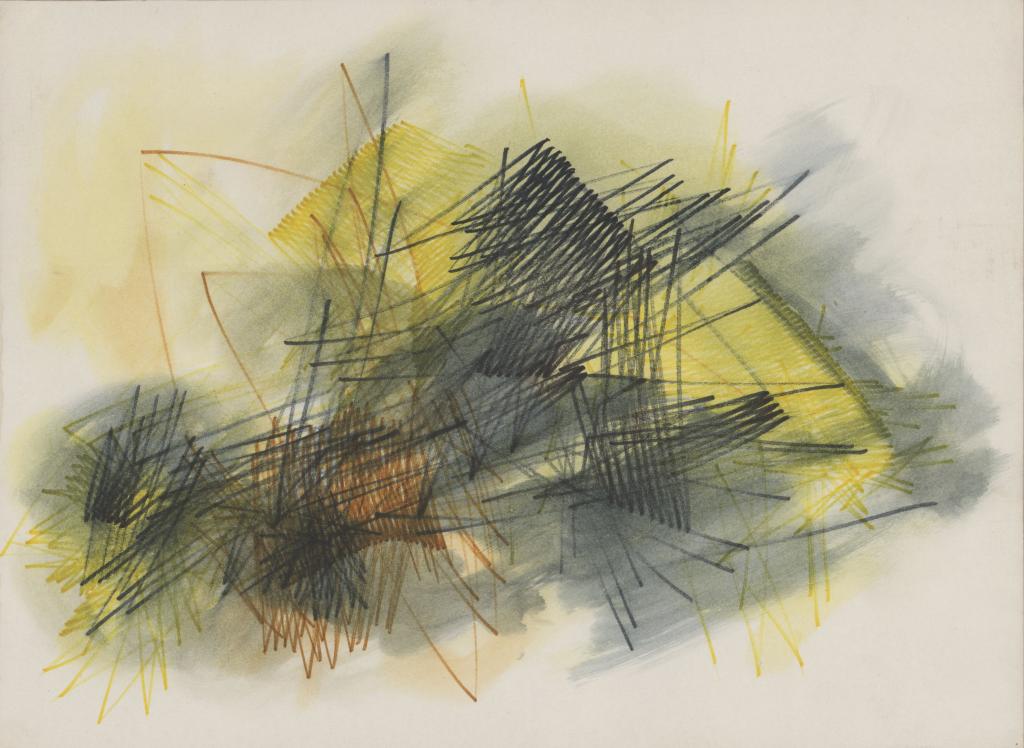
An abstract artwork of blues and yellows, with erratic pen marks, with the words 'Alice Berger Hammerschlag' stylistically imposed onto the artwork.

Alice Berger Hammerschlag

Alice Berger was born in Vienna in 1917 into a wealthy middle-class family. As a child she studied art with Professor Czizek, a pioneer in art education. She was very talented at drawing, winning an international prize for a ‘drink more milk’ poster at 10. Later, she was a student at the Vienna School of Applied Arts and the Academy of the Arts.   

In 1938 she came to Northern Ireland on a graphic design permit as a refugee of Nazi persecution. Initially living in Newtownards, she worked as a commercial artist in book illustration and textiles. The collective of Jewish refugees who had been brought to Northern Ireland on arts permits ran a shop in Bangor. 

She settled in Belfast on Ulsterville Avenue, where she had her studio, caring for both her and her husband’s parents, who she affectionately called her ‘old children.’ She primarily painted on the floor. She did not enjoy teaching or formal lecturing but loved to invite young artists and students to her studio to discuss art and wider philosophies.

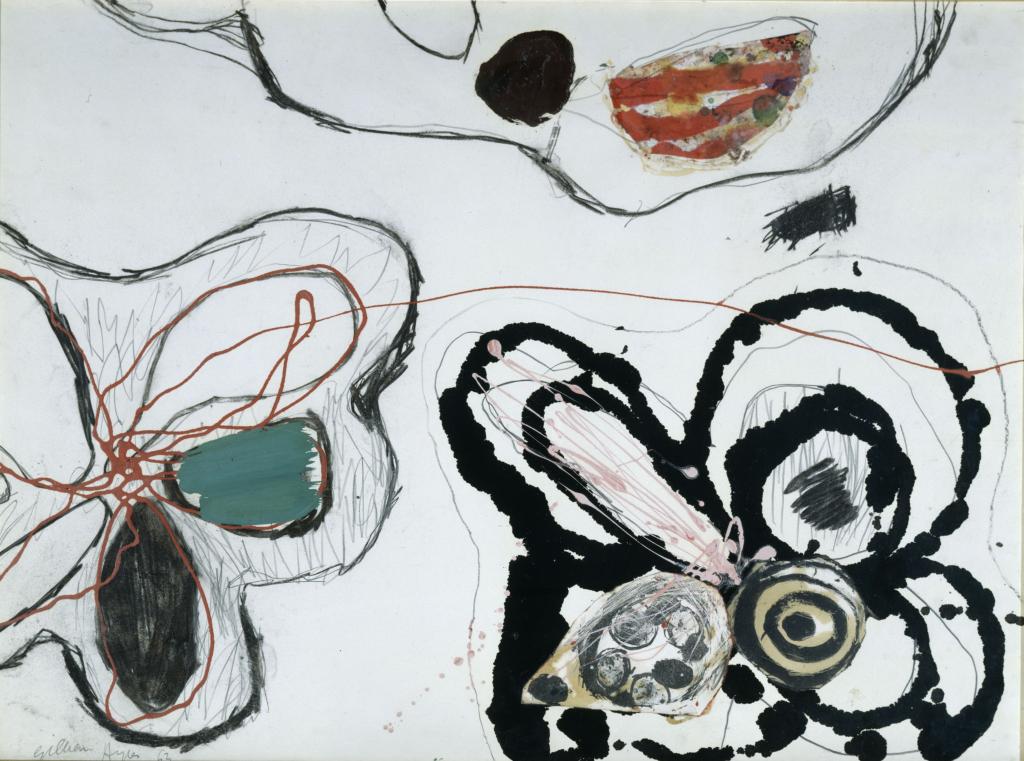
From 1963-1969 she was the director of the Lyric players' New Gallery on Grosvenor Road. Here, she championed many local artists by giving them their first solo shows. She also invited artists from Britain and Europe, including Gillian Ayres and Polish refugee and abstract artist Franciszka Themerson. 

Image
An abstract painting. On a white background, shapes like butterflies and flowers are made in black outline, with bursts of red and blue for colour.
'Untitled' (1963), Gillian Ayres. BELUM.U434. © Gillian Ayres

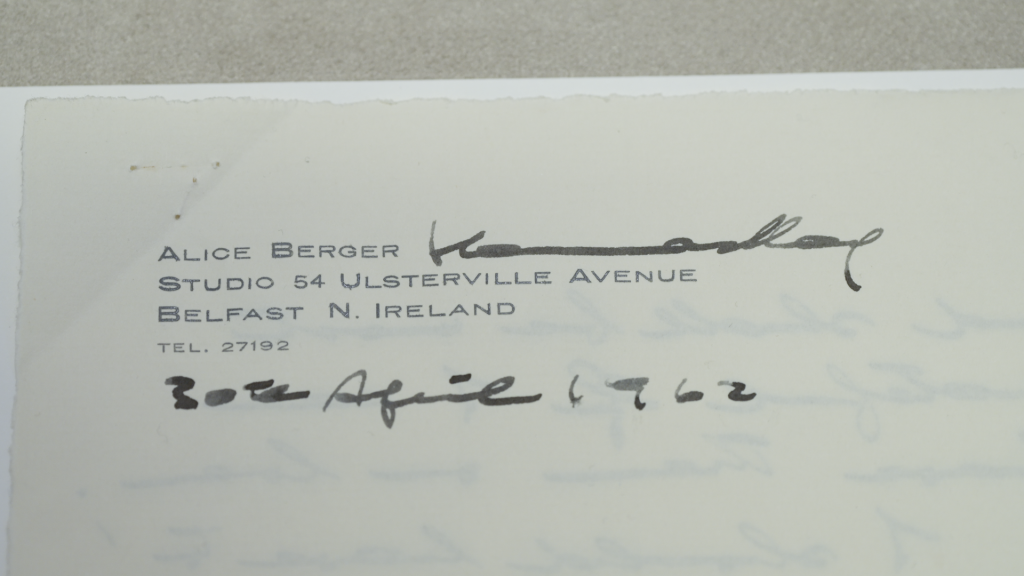
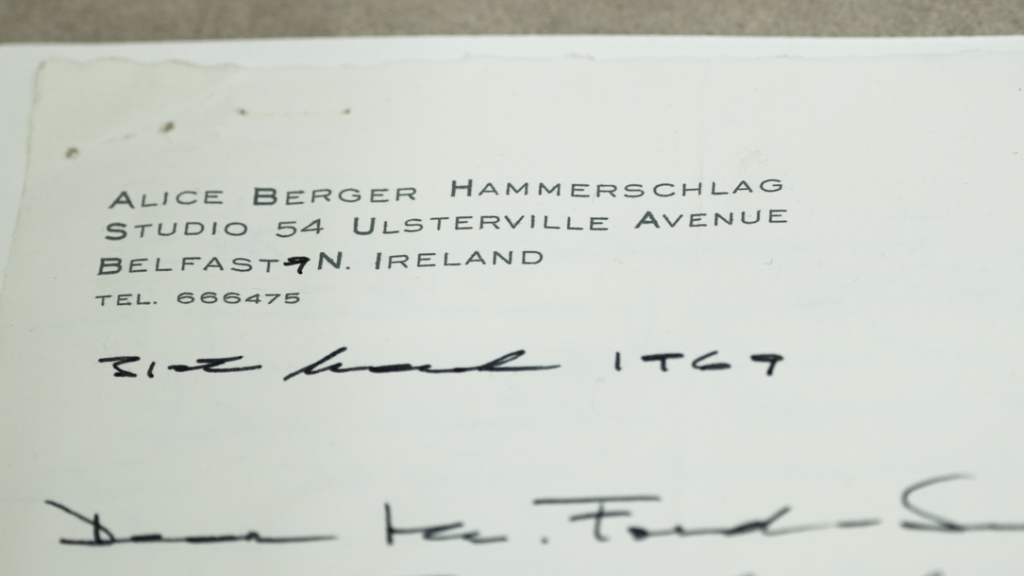
She was incredibly involved in the Lyric theatre, and friends with the founder Mary O’Malley and choreographer Helen Lewis. Berger Hammerschlag worked designing sets, and worked closely with Lewis who choreographed a dance inspired by her painting. She used Berger as her professional name, only using her married name, Hammerschlag, later in the sixties as a “nice gesture” to her husband Heinz. Helen Lewis considered her friend a feminist, saying: “she guarded this side of her herself, her career. A married woman has to guard her career, and fight for it.” 

Image
A letterhead from the desk of Alice Berger, where she has handwritten in her married name of 'Hammerschlag'.
Image
A letterhead from Alice Berger Hammschlag's studio, showing her full name typed out, instead of handwritten in.

On the 14th July 1969, Berger Hammerschlag died in Belfast, having painted up to the end.

In 1969, the Alice Berger-Hammerschlag Trust was founded by the painter Derek Hill (1916-2000), along with Gordon Woods, Cecil King, Kathleen Bell, T P Flanagan, Deborah Brown, Anne Crookshank, Neil Shawcross and Brian Ferran, as a fund to help young artists in Ireland. The award still runs today and is administered by Belfast School of Art, supporting Masters students in their practice.

Image
 Bed and Soil
Bed and Soil (2025) was an intervention in the Ulster Museum staged by Hannah Casey-Brogan. Casey-Brogan won the Alice Berger-Hammerschlag Award in 2014. © Hannah Casey-Brogan.

In addition to her work as an artist, Alice Berger Hammerschlag was founding member and treasurer of the Ulster Society of Women Artists, a member of the Belfast Arts Festival committee, and a member of The Women's International Art Club and The Free Painters and Sculptors, London.

In her lifetime, Alice Berger Hammerschlag was featured in multiple group and solo exhibitions globally. Her work is in many collections both private and public. 

Abstract Expressionism

Abstract art has many definitions and associated movements. One is Abstract Expressionism, and the notion that the gestural act of making is as important as the final artwork. 

The history of abstract art mirrors the history of many art movements: it does not reflect that artists who were women also pioneered these techniques and viewpoints. Berger Hammerschlag was one of the few abstract artists working at this time in Ireland.

Image
An abstract work on paper, with background colours of blue and yellow, with pen marks crashing across the page.
Yellow Drawing (1969), Alice Berger Hammerschlag

Alice Berger Hammerschlag considered her painting a gesture through which she expressed her innermost thoughts. Like some other abstract pioneers, there was a deep connection between her spirituality and her painting. She and her sister were dedicated in their research of global spiritual philosophy, often consulting with religious leaders and gurus of multiple world religions. Berger Hammerschlag’s spiritual interest and extreme pacifist politics resulted in her regular attendance at Quaker meetings. These intellectual and spiritual threads manifested in her work. 

Colour

Image
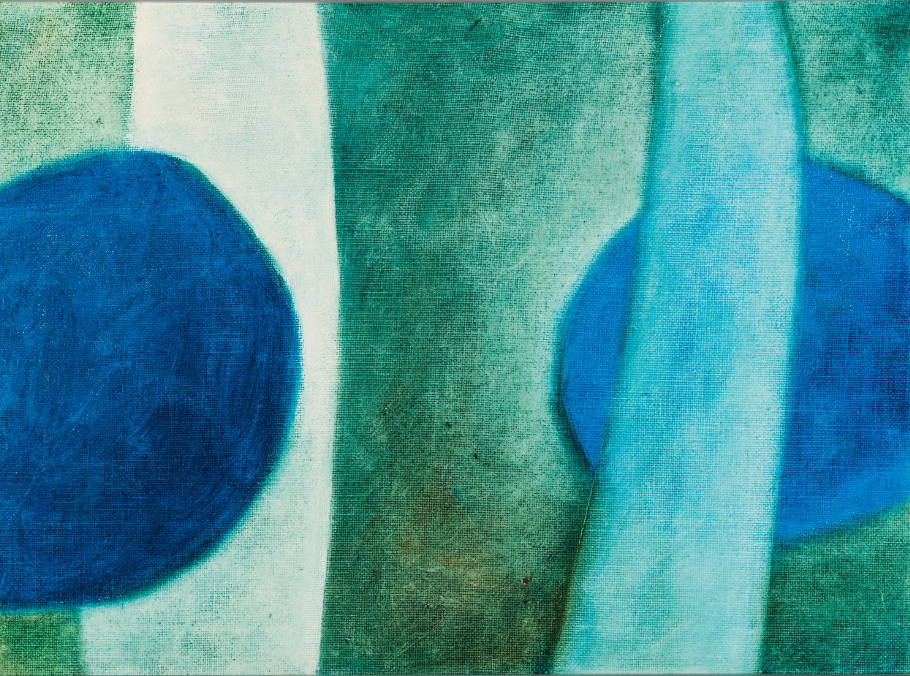
An abstract painting showing two blue circles. One, to the right, is bisecting by a thick, lighter blue line. The other is imposed on a thick white line. The background is otherwise green.
Barriers - Green Region (1964), Alice Berger Hammerschlag 

Berger Hammerschlag’s colour philosophy was translated by her close friend (artist and critic) Mercy Hunter. Hunter proposed that:

  • life and energy were shown with reds and earth colours 
  • greens symbolised growth 
  • blues and pinks stood for abstract values and positivity 
  • dull browns and blacks represented negativity. 

This attempt to formalise her process was not incorrect but cannot fully capture the fluid, and highly personal practice, that Berger Hammerschlag followed. Colours were evocative of feelings: blues were spiritual, yellow was wisdom, and, in addition to growth, green represented a personal connection to the earth.

Mercy Hunter: All colours have a special meaning to you, haven't they?

Alice Berger Hammerschlag: Oh definitely, yes, definitely.

Mercy Hunter: Could you tell - brown, for instance - 

Alice Berger Hammerschlag: Well, brown is essentially what it really, what you probably also would associate it with, is essentially an earth colour, and anything that's connected with it, but so is red and orange. Only these are more, these are the, let's say, pulling up colours, the, let's say the, positive values that exist on the earth's plane, if you know what I mean by that. If you don't just say, interrupt me, you know? Very happy actually, if you interrupt me, I would be very happy.

Student: Well could you explain a wee bit more further?

Alice Berger Hammerschlag: Well, you see there, I'm talking now of states inside as well of with outside, you know, and earth plane means, well we are living on this earth, you see, and anything on this earth like the good things, the bad, the desires, the ambitions, etcetera, etcetera. They needn't necessarily be all be bad, you see. An ambition can be a good thing, but it can of course become a bad thing, you know, once the actual purpose is blurred, you become so ambitious that it becomes useless. It becomes a negative thing. Therefore that to me changes into a dull red.

A bright red or an orange is a force to go on. You see, it pulls you up. But you see, that is a thing that I haven't thought out so much as it has really more or less presented itself but then I, over the years, analysed it, you know? Whenever I found a situation like that, somewhat presented itself in an orange upburst or in a semicircle, but always up. And when I hear of something that is perhaps called negative, somehow that's a dull, dull browny-black or dull red, you know, and that's how you evolve these things. You don't do them from a day to another, you know, then they become certainties, because they repeat themselves. 

And like blues, blues are for me - this word I must always use again for want of a better one - let's see, the spiritual qualities, you know? By that I don't mean moral, you know, and - moral, yes, up to a point, but not as it's generally understood: your own morals, your own values, you know. Very simple to me always, I mean, if a person is hurt, you know, by whatever you do, then it's wrong, you know? And that is a very good guide - it's, it's for me, it mightn't good guide for somebody else. But that for me is blue. You see, once you're conscious of all these things, you know, you step a little higher, you aim it a little more. You make hundreds of mistakes of course, but that doesn't matter. 

You know, all these things - if you want to ask anything - green for instance again is an earth colour, but for self recognition, you, you watch yourself a bit. You know, supposing you detect a little jealous or something like that. You detect it at certain circumstances and you don't like it too much, it always is unpleasant for oneself anyhow, and next time, when you don't expect it, you notice this again, well you check it, before you say anything, before you do the wrong thing, you try and check it. That is a green colour for me. It's like, it's like grass coming out. This is something new, something fresh, which you, if you don't take care of it, it's tired, but if you do, it gets greener and greener and blossoms, etcetera. 

Student: What about yellow?

Alice Berger Hammerschlag: Yellow for me is the, you see, this is the wisdom colour. This is, this is to me the the purple region. That's probably what I'll call it in the end, it's short enough. Purple is a very high region and I'm talking from inside, you know? It's wisdom plus very high spirituality. That means you really have sort of more or less this disregard for earthly wishes, desires, etcetera, but that can only evolve. I mean, if you do it by force, it's no good, is it? But this sort of - white is round also, and fairly light because it's movable. It can shrink, it can be bigger as needed, you know. Too much - no, there can never be too much wisdom because those who have it don't pronounce too much of it, you know, just whenever little is needed maybe, and it goes up, it floats.

Since childhood, her thoughts manifested as colour. Days of the week, emotions and actions were represented by certain hues (a condition called synaesthesia). Thinking she was ‘odd’, it was only when studying psychology as a teen that she discovered some others had the same cognitive variation.

Mercy Hunter: Would you say some of your thoughts about colour come from the East* rather than from - ? Or are they intuitive?

Alice Berger Hammerschlag: See I have to really think back an awful long time because it is partly what I always had as a child - and even didn't tell anybody, much later told my sister because she had some of these things too, you know, seeing like names in colour or people's - or weekdays in colour, numbers. And I thought I was odd, you see. I just didn't tell anybody. And then gradually much later, again, when I was about 15, 16, psychology at school, this came up, and then I knew that other people had it too, and then I became interested. Of course, you read a lot about it, but I really had my own colour combinations, really from ever since I can think, you know? And it isn't very out of the ordinary because quite a few people have that. Only you don't know, you think you are out of the ordinary if nobody else around you just happens to mention it, you know.

Mercy Hunter: What colour was Tuesday?

Alice Berger Hammerschlag: Tuesday is a, a greeny-yellow, but a greeny, not a very bright one. And Thursday's a real green.

Mercy Hunter: Is it?

Alice Berger Hammerschlag: Uh-huh.

Mercy Hunter: And Sunday?

Alice Berger Hammerschlag: Sunday's an almost off-white with a very pale sunny tinge.

*Eastern philosophy - prior to this section of their conversation, Hunter and Berger Hammerschlag were discussing philosophical traditions. 

Like her global Abstract Expressionist counterparts, Berger Hammerschlag’s art was immersive. She spoke about her paintings ‘coming forth into being’ through the action of painting. Though she continually sketched, she never drew in preparation for a canvas, feeling this made a painting stale. The rawness of the immediate reaction was important. 

Mercy Hunter: Well then do you, you do preliminary sketches for these big ones.

Alice Berger Hammerschlag: No.

Mercy Hunter: You don't.

Alice Berger Hammerschlag: No. No, because no, they make them stale, I found, for me.

Mercy Hunter: These small ones, do they lead up to big paintings or not?

Alice Berger Hammerschlag: I always have a fond idea that they will, but I know they don't.

Mercy Hunter: Yes. 

Alice Berger Hammerschlag: You know? They present eh - oh, yes, they come again. I had one seam of essence or a scent, whatever you call it, and they started as small ones, you see, and I made bigger ones, but they were totally different. You see, it was a climb up. But the one stood as it was, because if I - that only goes for me, it may work quite differently for anybody else - if I make a sketch and try to redo it, it loses a great deal of freshness. I think too much. I almost copy too much, you know, of course, if you compare. It loses for me almost the essential part. You know - I just hardly ever do it. I leave a sketch, a sketch.

Mercy Hunter: Now, the last time I was here, you told me that you will not exhibit a picture until you have lived with it for a certain time.

Alice Berger Hammerschlag: Yes, at least three months. Yes, that's right. Yes?

Student: Why?

Alice Berger Hammerschlag: Well, the reason simply being because a picture can die on you.

She did not want her paintings to be interpreted symbolically; the colour representation was personal, but marks did not represent real world objects. She recognised that the viewer would interpret the painting in their own way.

Some get it completely, others get quite something else, which I’m quite sure is there. I always maintain the things that you do not put there on purpose are probably the most important.

Student:

Do you think the ordinary person looking at your paintings would understand what you meant?

Alice Berger Hammerschlag:

Well, quite a lot do, and the majority doesn't, you know? But the majority I think doesn't because they simply aren't interested in pictures really, you see, because those who are, always get something. It's always a fringe of what I wanted to get - some get it completely, others get quite something else, which I'm quite sure is there, which is, I always maintain, the things that you do not put there on purpose are probably the most important, you know?

She recognised meaning as evolving and experimental, and she invited the viewer into this experiment. 

It is clear her painting was a fluid connection between her thoughts and emotions on the canvas. Arts Council director Kenneth Jamison described her work as a re-enactment of past experience and traumas, an “art of emotion recollected in tranquillity”. The growth of abstraction as a visual outlet for artists took place alongside major world events. Berger Hammerschlag was a both a victim of these events and a close observer. These paintings are a culmination of the events and interests of her life, though as actions, not reactions. 


The audio recording in this story features Mercy Hunter, participating students, and Alice Berger Hammerschlag. To date, we have been unable to locate a copyright holder for this recording and we would be keen to get in contact. If you have any information regarding this please contact [email protected]